
Communities Deserve to Know What the Data Center Boom Could Cost Them
In Indiana, a utility and one of the largest companies on earth signed a fifteen-year power contract with a clause letting the customer cut its commitment nearly in half on a date certain. A regulator approved it in June. The generation gets built either way, and the households who never signed anything are the ones who cannot leave.
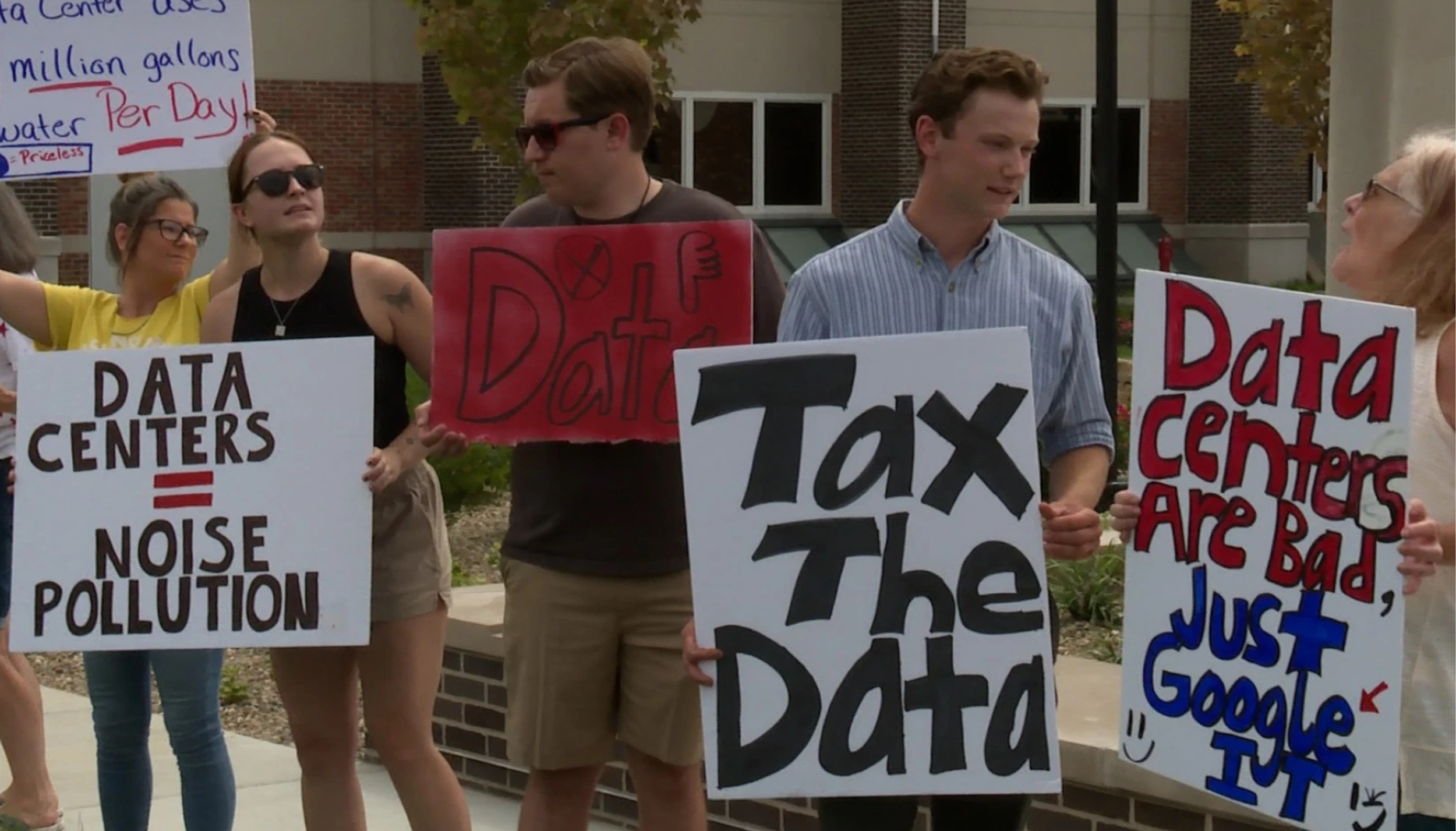
Christine Voss stood up at a Clinton, Iowa city council meeting in August and told the room what she was not against.
"We are not against technology, innovation or progress," she said. "We are for transparency, accountability and protecting what matters to our community: our land, our water, our voice, our future. No data centers. Let the people decide."
What she was testifying about is a document. Clinton's city attorney, Patrick O'Connell, drafted the city's first ordinance governing data centers and brought it to the planning commission in July.
"This is 16 pages long," he said, and the difficulty is that the industry keeps producing problems nobody wrote rules for yet. Sixteen pages is what stands between a city of about twenty-four thousand people and a campus that QTS, owned by affiliates of Blackstone, has been exploring near the municipal airport at a reported ten billion dollars.
Residents who have read those sixteen pages keep returning to two words. The draft says the city may require things. They want it to say "shall." May require water reporting. May require independent noise monitoring. May require a road-use agreement, a buffer, a decommissioning bond.
Each of those is a cost, and that one verb decides whether the cost sits with the company or with the town. A discretionary standard is one a future council can quietly decline to apply, in a negotiation the public does not attend.
Pull quote: A discretionary standard is one a future council can quietly decline to apply, in a negotiation the public does not attend.
Hold one question against your own county before the end of this piece. If a data center is canceled, downsized or loses the customer it was built for, who is contractually required to pay every remaining dollar? Not who says they will. Who is required to. That answer lives in signed documents, and where it cannot be found, the public is financing a private bet without being shown the downside.
Why A Town Says Yes
Start with the squeeze, because it explains the whole sequence. Linn County planning director Charlie Nichols described what Iowa's new limits on property tax revenue did to every local government in the state.
"What the property tax change does is it makes it very clear to local governments, and that includes school districts, that if you are not growing, you are shrinking. You're going to be cutting," he said. "So it now makes it imperative that communities proactively try and plan for growth."
That is a town negotiating from need rather than from strength, and the industry knows the difference. Then comes the second half. Iowa exempts computer equipment from assessed valuation, which means these facilities pay less property tax here than they would in many other states. Nichols, whose job is attracting development, called it "a massive, massive property tax cut, which, in my opinion, should be repealed."
Against that, two things the public does not have. QTS says it will pay for the energy infrastructure its project requires and that existing Alliant Energy customers will not see costs shifted onto them.
It also declines to disclose the power capacity it is requesting, citing confidentiality. The assurance is public and the number behind it is not, which leaves the regulatory record as the only place a resident can test the promise. A corporate FAQ is a statement of intent. The ordinance, the permits, the utility agreement, the development agreement and the performance bond are the things that bind.
The Clause With A Date On It
To see where Clinton's choice leads, you’ll need to go four hundred miles east, where the same choice was made and the paperwork is now final.
The Indiana Utility Regulatory Commission holds a fifteen-year special contract between the utility NIPSCO and Amazon covering up to 2,400 megawatts of data center load, supported by roughly 3,000 megawatts of generation, ramping through 2032. The customer makes fixed capacity payments.
An affiliate generation company supplies the utility under a power purchase agreement, and the filing sets out depreciation schedules for assets built to meet the obligation. On June 17, 2026, the commission fully approved the settlement, the special contract and the related power purchase agreement.
Inside it sits the sentence that gives this piece its title. Amazon holds a one-time option, exercisable by March 31, 2029, to reduce its commitment by 1,200 megawatts. Half the load, on a date certain, at the customer's discretion.
The plant is a thirty-year asset. The commitment behind it has an exit dated 2029.
Be careful what that does and does not establish, because the careless version is what lets a utility dismiss an entire investigation.
Reduction options are ordinary in large industrial contracts, and a customer who negotiates one is doing what a competent counterparty does. The filing does not say anyone's bill will rise, and neither does this piece. What it establishes is that the off-ramp exists, it has a date, and generation is being built against a commitment that can legally shrink by half long before that generation is paid off.
Indiana has been generous alongside it. Good Jobs First reports the state forwent about $655 million in data center sales tax exemptions cumulatively from 2019 through 2025, with Amazon accounting for roughly $611 million across 2024 and 2025 alone.
NIPSCO's parent projects about $1.4 billion in customer bill credits over the term, which is a company forecast and should be read as one until credits appear on bills.
The Citizens Action Coalition, which intervened in the docket, argues the figure should be closer to $3.5 billion if Amazon paid the transmission rates existing industrial customers pay. That gap is the argument, and it is being had by named parties on the record.
The generation itself sits in a company NIPSCO created, which builds plants for data centers outside the traditional rate base. The utility says this protects existing customers. Kerwin Olson, who runs the Citizens Action Coalition, called the arrangement "a shell game, a scam." Kenneth Davies, who runs a data center developer called Takanock and therefore has no reason to defend ratepayers, called it "anticompetitive."
The city at the center of this is Gary, where the poverty rate runs near a third. In August, after a storm, roughly twenty-two to twenty-four thousand NIPSCO customers there were still without power ten days later.
Gary council vice president Darren Washington put the question about rates to a public forum this way: "Are we really going to force low-income households, working-class Hoosiers, single moms, retirees, disabled veterans..." Michaela Spangenberg of the Gary Education Coalition was blunter about the timeline. "We need something to protect us now."
Money Needs The Grid Faster Than The Grid Can Be Built
The pressure both towns are feeling is generated on balance sheets that have nothing to do with either place.
In the second quarter of 2026, Alphabet's capital spending ran ahead of the cash its operations produced, and the company raised full-year capital guidance again. Fitch Ratings named the risk of an AI market correction among the top global credit risks in July.
The Financial Stability Board, in its May 2026 report on private credit, named the construction and operation of data centers as a channel through which delays and cancellations become credit losses. The Bank for International Settlements addressed the same ecosystem in its 2026 annual report. None of those are advocacy groups.
The money needs the grid faster than the grid can be built, and towns are the part of the system that moves slowest and can be leaned on hardest.
Underneath the spending sits a larger number that does not appear as debt. In their mid-2026 filings, five companies disclose roughly $2.6 trillion in leases that have not yet commenced plus non-cancelable purchase and construction commitments.
Meta alone reports $278.99 billion of uncommenced leases running out to 2036 and $349.31 billion of non-cancelable contractual commitments, and then discloses that in July it signed about $68 billion more.
| Company | Uncommenced leases |
Purchase and construction |
|---|---|---|
| Alphabet | $85.2B | $811.0B |
| Meta | $278.99B | $349.31B |
| Microsoft | $329.1B | $228.6B |
| Oracle | $260B | $13.3B |
| Amazon | $137.2B | $130.1B |
This is not hidden debt. It sits in the commitments footnotes of public filings, which is the least secret place in American finance. It is disclosed future obligation, much of it not yet recognized as debt or lease liability on any balance sheet, and that is the point. If AI revenue justifies the buildout, these are simply the cost of doing business. If it does not, they harden into fixed costs at the exact moment returns fall.
What A Guarantee Actually Guarantees
One arrangement shows the machinery without anyone having to characterize it. In an 8-K filed in August, Nvidia disclosed that it "entered into multiple residual value guaranties" covering leases for about 4.25 gigawatts of IT load at a site in Portsmouth, Ohio, with its "aggregate payment obligation cumulatively capped at $105 billion."
If the leased assets fall short of their guaranteed minimum value, Nvidia pays the difference. The lessor is SB Energy. The tenant is an affiliate of OpenAI. Nvidia filed it under the item reserved for creation of a direct financial obligation.
Then comes the clause that matters. "OpenAI has agreed to reimburse and indemnify NVIDIA for any and all amounts actually paid by NVIDIA to the Lessor."
Read that twice. The guarantee that makes the lease financeable is itself backstopped by an indemnity from the party whose ability to pay is the entire question. Nothing in it is improper and all of it is disclosed. It is simply what the structure looks like when you follow the obligation around the circle and arrive back where you started.
The Honest Counterargument?
The case for these projects is real and it is made by people with standing to make it. Dylan Gramlich, a lobbyist with the Laborers' International Union of North America, testified in support in Clinton.
"Virtually every union in the state of Iowa supports the responsible development of new data centers," he said, asking the council to let the work happen so that "the Clinton communities can realize these benefits and not other surrounding communities."
QTS has committed five million dollars to workforce development there. Construction wages are real wages, and the tax revenue these facilities do pay is real revenue. The honest limit is that none of that answers the question this piece is asking. A building boom and a durable local economy are different things, and the contract terms decide which one a town ends up with.
One more thing should be said plainly, because the temptation runs the other way: no American data center project since 2023 has been documented as canceled after a public entity already built infrastructure for it. The mechanism is on paper. The failure has not happened. That is precisely why the documents being signed right now decide who pays if it ever does.
Who Pays If the Data Center Boom Falls Short?
The 2008 financial crisis showed how the consequences of an investment boom could spread across households and communities. The data center buildout raises a related question: who pays when investments based on expectations of continued growth fail to deliver?
Utilities are planning substations, transmission lines and power supplies around projected data center demand. If a project closes, scales back or never opens, the infrastructure built to serve it may still need to be paid for. Depending on the utility’s rates and contracts, some of those costs could fall on households and businesses that had no role in the investment.
The good news is that regulators already have tools to reduce that exposure.
In November 2025, Virginia’s State Corporation Commission approved a separate electricity rate category for Dominion Energy’s largest customers, including data centers. Separating these customers allows regulators to identify and assign the costs of serving them.
Oregon regulators have approved a separate rate structure for large data centers served by Portland General Electric, along with contract requirements that impose charges when customers fail to use infrastructure built for them. The stated purpose is to protect other customers from subsidizing that expansion.
Indiana has its own precedent. A settlement filed in 2024 and approved in February 2025 established long-term contracts, minimum billing requirements, financial security provisions and exit fees for qualifying large customers of Indiana Michigan Power. These requirements are intended to limit the costs transferred to other customers if a major user reduces demand or leaves.
Companies should remain financially responsible for infrastructure built to serve them, even if their plans change. That means enforceable financial guarantees and funds held in escrow, repayment of public incentives when commitments go unmet, and money set aside for closure and site restoration. Officials should also require independent reviews of demand forecasts before approving projects. These safeguards already exist. It just requires actually doing it.
What Comes Next
Public opposition to data centers is substantial. A May Gallup poll, reported by The Washington Post, found 70% of Americans opposed data centers in their communities. And a UMass Amherst survey in September found just one in nine Americans support construction in their own community.
On November 3, some voters will have a direct say. Data center measures are on the ballot in 18 Ohio communities. Nine are considering bans on facilities exceeding a 25-megawatt threshold; Urbana’s proposed limit is 7.5 megawatts. Hubbard voters will consider a complete ban, while Grove City would require a citywide vote on new heavy industrial projects.
In Wilmington, where Amazon Web Services announced a $4 billion development, residents have pursued federal lawsuits and four referendums challenging the city’s zoning decisions.
Meanwhile, the Environmental Protection Agency has proposed eliminating federal public notice and comment requirements for certain air permits used by data centers and other industrial facilities. State and local regulators would decide whether to retain those opportunities. Nearly 200 environmental, health and community groups have urged the agency to withdraw the proposal.
A town can only argue about a permit it knows was filed.
Here is my read, and you can hold me to it. None of this gets fixed federally in time to matter for the towns deciding right now. The wins that count over the next two years will be municipal and unglamorous, made by people who read a draft ordinance on a Tuesday night and asked why one verb was optional.
That is not a consolation prize. It is where the leverage actually sits, which is why the applicant waits in the room while the rules get written, and why somebody is working to shorten the list of things you are entitled to be told.
So go find out. Pull your county's draft ordinance and search it for the word. Ask who signed the utility agreement and whether anyone outside the room can read it. Ask what happens if the tenant leaves in year six. If the answer is confidential, or nonbinding, or rests on demand that has not arrived yet, you already know who is carrying the risk.
In Indiana, an exit was written into the contract, with a deadline attached. Gary received no such protection.