
Driven by Corporate Greed, Water Bills Rising 19% Faster than Household Income
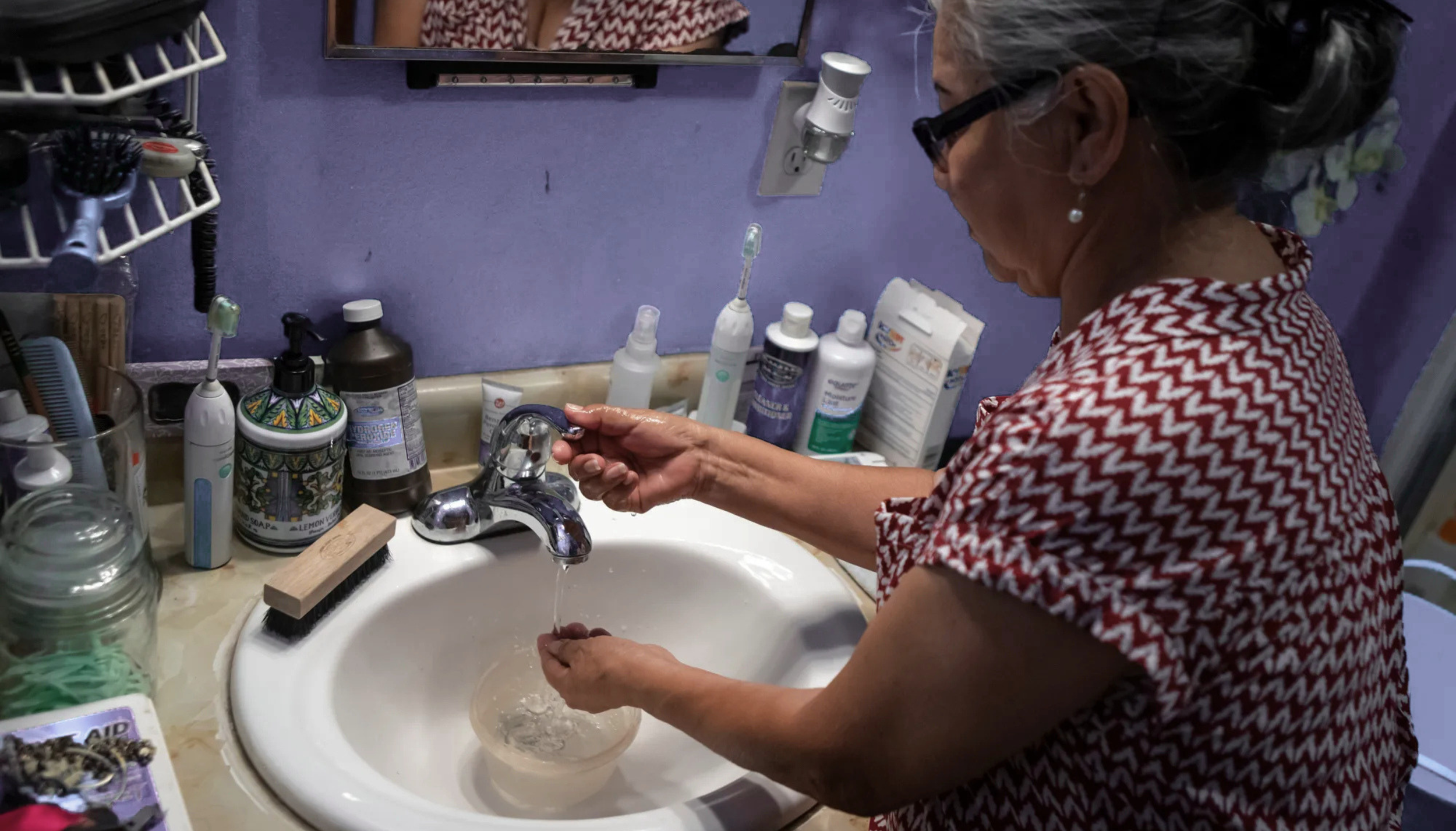
María Díaz keeps a bowl in the sink while she washes her hands to save water in central California.
Photo by Larry Valenzuela, CalMatters
Get the story, the context and somewhere to go with it in 5 mins or less.
Read more storiesA new report from Food & Water Watch, a D.C. based nonprofit, highlights the explosive growth of drinking water bills across American households already testing the limits of their ability to afford day to day life.
Compiling and analyzing water billing data across 500 of the largest community water systems together serving 45% of the U.S. population, the report found that from 2015 to 2025 household drinking water bills increased faster than "inflation, grocery prices, and median household income," with the average community water system increasing prices by an egregious 62%.
That places water bill inflation at 1.6 times overall inflation rate, and even more than twice that of groceries despite the latter being one of the most painful sources of inflation. Water bills grew 19% faster than U.S. median household income, yet another way in which the meager wage increases following the COVID years have seen their gains wiped out entirely by cost-of-living spikes.
The new report offers a map which can be used to locate your own water system and its price increases (assuming data was collected on it).
Why this news matters
Americans are being crushed by the cost of living, full stop. Americans are struggling to afford the basics that make life livable, from housing and energy to childcare, food, and education.
A 2023 study by Urban Institute found that 49% of American families didn't have the resources to cover essential expenses necessary for a secure life, and since not one economic indicator has improved since 2023 (quite the opposite), we can now confidently assume that this figure is well over 50%.
More than half of all Americans can't 'do life,' basically, as in it simply costs too much. It's not Doordashing or whatever (though yes, you really shouldn't use Doordash); it's not reducible to bad spending habits, and in any case, the economy depends heavily on the consumerist spending habits everyone was raised with anyway.
It's the fact that the lifestyle people were raised with and the economic realities they are confronted with today are fundamentally incompatible; that even if they wanted to buy something to support a local business, they generally can't justify it because rent is bearing down on them at half or more of their monthly income.
Because a cart of groceries at even Aldi is suddenly quite easily several hundred dollars when it used to be $100 for that same cart. Because major retailers are being routinely busted for overcharging customers on the things they're already barely affording, supercharging food inflation by exploiting expectations that prices will rise.
Because something like water, the very essence of life on this planet and the most urgent of all human physical needs, something one literally dies without in a few days, has become subject to financial speculation and privatization just so that the same handful of people making every aspect of your life worse already can make that little bit more money.
Very little matters more than what is being done within water management and privatization at a time when fresh drinking water is literally running out globally, at a time when the U.N. has declared the world to have entered an age of water 'bankruptcy.'
The new report offers a map which can be used to locate your own water system and its price increases (assuming data was collected on it). Most importantly, it found that for-profit water systems charged an average of $823 for water in 2025 compared to $494, a 67% increase. That's what they really mean by 'private sector efficiency'— the more efficient funneling of your money into a handful of pockets.
The report makes it clear: "Without action to restore federal support for public water systems and rein in corporate water abuses, water bills will continue to increase faster than households can reasonably absorb." Water privatization simply needs to be banned.
Take Action
So, what can we do?
Organize with people doing the work and push for policies that protect your community’s supply.
Start locally
Your community has a say.
Water rates are often decided locally. Find out who sets yours and when they meet, then show up together.
-
Attend rate hearings
Bring neighbors to municipal hearings and utility rate cases. Submit comments and challenge proposed increases.
-
Keep water public
Organize against privatization and support water systems accountable to the communities they serve.
-
Push back on data centers
Oppose new construction, attend planning meetings and demand disclosure of water use, infrastructure costs and effects on household bills.
Find your people
Food & Water Watch
Explore research, sign up for action alerts, attend events, volunteer or donate to support its campaigns.
Corporate Accountability
Connect with its campaign against water privatization and organizing for public water solutions.
River Network
Find water policy resources and connect with a national movement, including the Water Equity and Climate Resilience Caucus, of which River Network is a member.
Invest in public water
WATER Act
The Water Affordability, Transparency, Equity, and Reliability Act would create a dedicated trust fund for water and sewer infrastructure.
Introduced by Sen. Bernie Sanders and Rep. Bonnie Watson Coleman.
Ask your senators and representative to support and cosponsor the bill.
Read the billKeep water affordable
Water Access and Affordability Act
Would establish a permanent federal low-income drinking water assistance program at the Environmental Protection Agency.
Sponsored by Rep. Rashida Tlaib. Introduced April 13, 2026.
Ask your representative to support and cosponsor H.R. 8254.
Read the billMake data centers pay
Ratepayer Bill of Rights Act of 2026
Would require data centers to disclose water and electricity demands, protect local services and pay the costs their construction and operations create.
Urge your representative to support protections against passing these costs on to households.
Explore the proposal