
After a Century of Decline, New Yorkers Are Helping the American Chestnut Tree Grow Again
More than a century after chestnut blight was first documented at the Bronx Zoo, young hybrid trees are taking root there as researchers and residents work to restore the American chestnut.
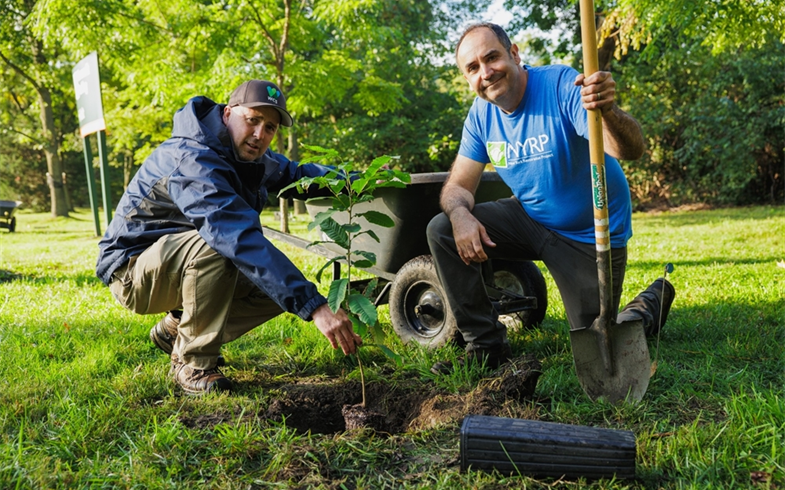
A tree that once fed communities and filled eastern forests is getting another chance to grow in New York City.
On October 5, a group of local gardeners and conservationists planted 20 young hybrid American chestnuts at the Bronx Zoo, joining an effort by the Wildlife Conservation Society, New York Restoration Project (NYRP) and The American Chestnut Foundation (TACF) to help the species recover.
The trees represent a small step toward restoring a species that once numbered nearly four billion across eastern North America. For thousands of years, Indigenous peoples gathered chestnuts and managed landscapes to support their growth. The trees later became central to rural economies, providing food for livestock, nuts to sell in city markets and rot-resistant timber used in homes, fences and railroad ties. Their harvests also sustained bears, deer, squirrels and wild turkeys.
That abundance began to unravel when a fungal pathogen arrived on imported Asian chestnut trees. First documented at the Bronx Zoo in 1904, the blight spread through forests with little natural resistance, killing billions of chestnuts within roughly half a century. By 1950, the species had largely disappeared from the forest canopy, depriving wildlife of a dependable food source and communities of a tree woven into everyday life.
More than a century after the disease was identified on its grounds, the zoo is now helping write the next chapter of the chestnut’s history, with NYRP’s Executive Director Lynn Bodnar Kelly describing the October 5 planting as “an invitation to imagine what our urban landscape can look like in the future.”
“For generations, this remarkable tree was a defining part of our forests, and its loss changed the landscape in profound ways,” Kelly said in a recent statement. “Through partnerships like this one, we have an opportunity to help restore the chestnut while inviting New Yorkers to be part of its return.
According to TACF, millions of chestnut sprouts still emerge from surviving roots, however most become infected before reaching maturity, which leaves the species functionally extinct in the wild. Those surviving trees preserve genetic diversity that researchers are working to carry into future generations through breeding programs across the species’ historic range.
To give those future generations a better chance of reaching maturity, TACF restoration programs have crossed American chestnuts with Chinese chestnuts, drawing on the latter’s greater resistance to the fungus. By following these hybrids over time, researchers and restoration partners can assess their growth, disease resistance and ability to reproduce.
Some of that work is already bearing fruit in northern Manhattan’s Highbridge Park, where NYRP and its partners began planting a grove of hybrid chestnuts in 2017. By December 2025, the organization reported that the grove contained more than 200 trees, several of which had been producing nuts since 2023. Only one had been lost to blight.
As the effort expands to the Bronx Zoo, TACF says the plantings offer another greater opportunity to learn how the trees grow and respond to disease.
“These trees do more than reconnect New Yorkers with a lost part of their natural history,” said Michael Goergen, president and CEO of TACF. “They become part of a living restoration network, helping us learn which trees can survive, grow and ultimately reclaim their place in forests and communities of the future.”
The foundation is also using genetic testing to identify promising breeding trees before they mature, allowing researchers to select the next generation sooner. The goal is to improve disease resistance while preserving the genetic diversity that will help chestnuts grow across their native range. Lasting recovery will require trees that can withstand blight and other threats, including Phytophthora root rot, and eventually reproduce in forests without assistance.
Of course, understanding how these trees grow and respond to disease requires years of care and observation, which is why NYRP is inviting New Yorkers to help steward the American chestnut’s return through its 1,000 Chestnut Challenge.
Launched in 2025 with conservationist Bart Chezar and TACF, the community project aims to establish 1,000 thriving chestnuts across NYC’s five boroughs. Residents receive free saplings and guidance on planting and care, with a commitment to tend the trees and report on their health and size each year. By tending to and monitoring saplings in their communities, participants can help researchers learn which trees hold the greatest promise for future restoration.
For New Yorkers, the chestnut’s return offers a chance to help repair an ecological loss that has shaped forests for more than a century. The saplings they care for today could one day shade neighborhood paths, feed wildlife and produce seeds for future forests, giving the next generation a living connection to a tree many people have never known.
That possibility, like so much of conservation, will depend on people choosing to care for a landscape whose recovery will extend well beyond their own lifetimes.
