
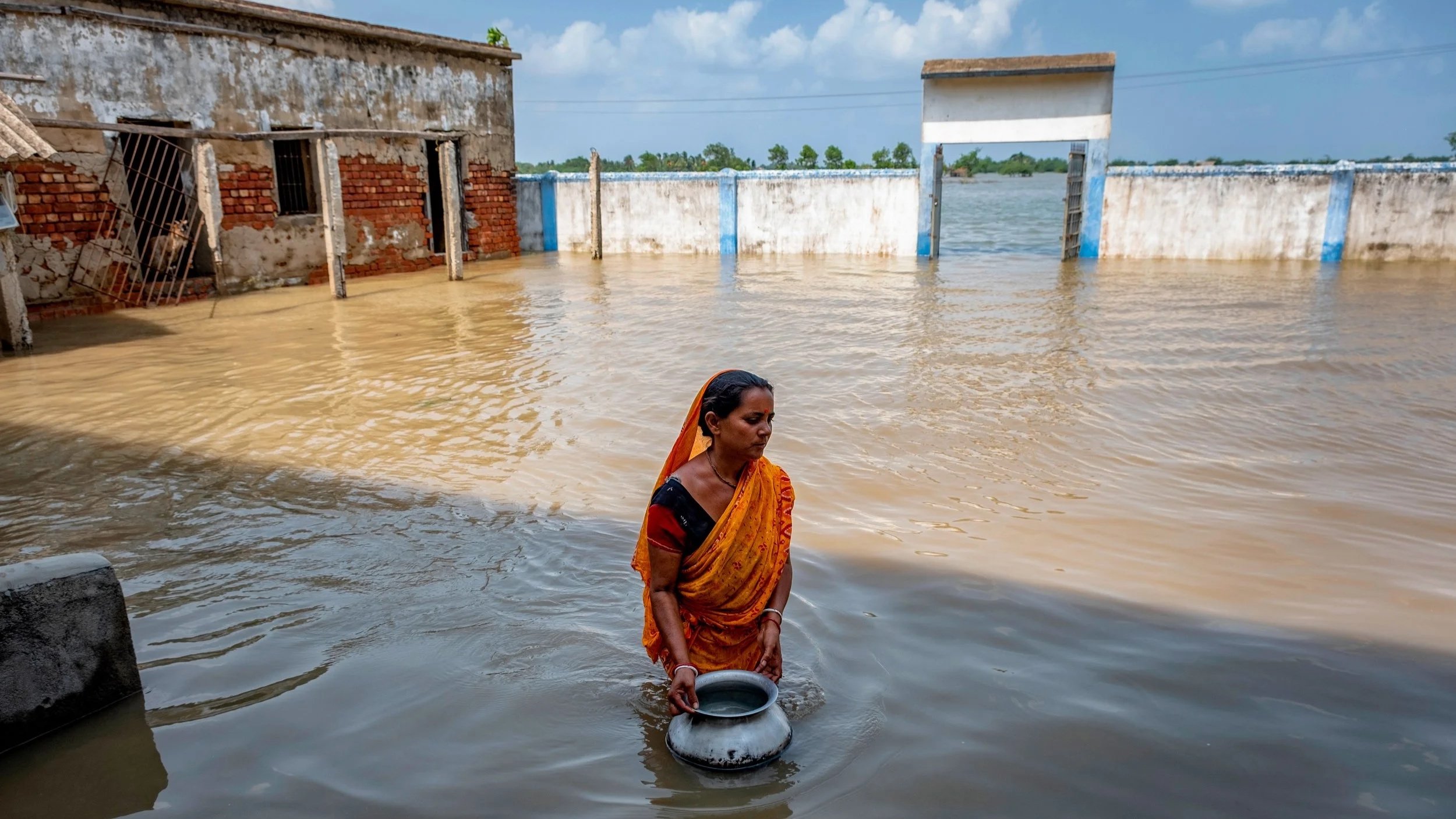
Here’s what’s happening:
There is no bigger story than this: the new U.N. 2026 Emissions Gap Report is using the strongest language yet from the international body to emphasize that global civilization's current carbon trajectory has shot wildly past 1.5°C.
The report emphasizes that nations must collectively correct urgently to avoid consequences that will collapse major systems and cause unprecedented loss of human life.
"Decades of insufficient mitigation action means that larger exceedance of 1.5°C above pre-industrial levels based on multidecadal averages is now imminent and unavoidable. Exceedance does not mark a single uniform state of risk.
Every additional fraction of a degree and additional year of warming above 1.5°C raises the risk of irreversible changes," explains the report, and that to keep warming below 2°C—where extreme impacts are already forecast for the stability of human civilization—grave action needs to be taken now.
"To get on such a pathway, global greenhouse gas (GHG) emissions must be reduced by 18 per cent by 2030, 45 per cent by 2035 and 69 per cent by 2040, all relative to 2025 levels," but the report further acknowledges while 63 countries have decreased their emissions over the past decade, these are outweighed by 124 countries increasing theirs.
"If current policies continue, there is a 66 per cent chance that warming will be limited to 2.8°C by 2100," a result which would essentially result in the end of the world order as we know it.
According to a report from risk management experts at the Institute and Faculty of Actuaries (IFoA) together with the University of Exeter, a 2025 report on future climate risks warns of potential 50% loss of GDP between 2070 and 2090 from climate shock, and much worse, the potential loss of 4 billion lives in a 3°C scenario (though this hypothetical requires further study).
Critically, the U.N. report notes that the most optimistic outcome projections have worsened significantly due to the withdrawal of the U.S. from climate agreements.
Why this news matters for all of us:
Deficits in science literacy are one of many hurdles climate advocates must overcome when discussing how serious the situation is with our warming planet. What is at risk here is not merely some rich boomers you don't care about anyway losing their multi-million dollar homes in Key West or some melted ice caps and sad polar bears. We have crossed most of the key planetary tipping points, and warming is a driver of several of them.
These range from plummeting biosphere integrity (the loss of thousands of species in what is now understood as the sixth mass extinction or the "holocene extinction," an age defined by the dominance of human life and its impacts on all other life) to acidification of the ocean.
These processes have overwhelming impacts on human life; the loss of biodiversity is itself a tragedy, but also implies the destruction of ecosystems we rely on for the ongoing cleanliness and function of rainforests, oceans, and other key systems we rely on for food, medicine, and climatological regulation.
The acidification of the ocean, driven by the absorption of excess carbon in the atmosphere, has profound implications for the deoxygenation of the oceans, warming trends, and the integrity of marine ecosystems which coastal regions are often significantly if not wholly dependent on for their survival.
Yet, some of the most direct impacts of the added heat come from a combination of poorly adapted cities experience heat-stroke related fatalities, mass displacement, and the failure of food production on systemic scales.
Notes one 2026 study in Nature Health, in Europe between 2000 and 2025, there were a staggering 430,365 heat-related deaths: "...summers with similarly large expected mortality burdens have become more frequent in recent years. These findings show that anthropogenic climate change has already greatly increased expected heat-related mortality across European cities."
Then there's the simple realities of mass displacement. While, again, 1.5-3°C of increased warming does not sound like a lot on its face, the way it interacts with complex systems such as those that produced this year's Super El-Nino mean that elevated "non-survivable" heat-waves that occur one-after-the-other during warmer months will displace millions and even billions of people in equatorial regions with no clear place for them to go, particularly at a time when a growing number of nations have hostile popular sentiment against immigration—a trend that will surely continue (and continue to be exploited by the worst among us).
But perhaps scariest of all impacts--and one which will dramatically impact the economic survivability of working class people globally now and into the future to say nothing of impending famine--is the impact of rising heat on food supply chains and resilience, particularly when combined with the impacts recent global conflicts have had on supply chains.
Anyone who has ever attempted to grow a bell pepper can tell you how sensitive many crops are to changes in humidity, rainfall, heat and sunlight. To give but one example, in response to the unprecedented heatwaves in the U.K. in the past year have resulted in widespread crop failures and harvest projections that are the worst since 1984.
In fact, according to an Energy & Climate Intelligence Unit report from August, the U.K. is on track for its smallest harvests on record "by a wider margin than previously expected." And that's just from 2025's heatwaves, for which the U.K. was simply unprepared.
As citizens of a thoroughly industrialized world that has benefitted from industrial agriculture to cause a boom in the global population, there is no going back from those systems collapsing. We cannot collectively decide to live more simply or live off the land or any other primitivist fantasy.
For the great mass of people on the planet, either this is a problem that is solved, or billions are at risk of famine to make no mention of the political, social, and economic chaos mass famine would cause. It's that serious.
As a 90s child whose faith in human systems had not yet been shaken and whose hope for the future was ever-bright, I always imagined that if the world ever were to face a grave existential threat like climate change that scientists would make a "serious announcement" we all stopped and listened to.
After all, it's always after that point in the movie that the world would get its act together and act—rationally and decisively—on that information in time to stop the 'End of the World' and save the day. Even in my adult life, I have awaited a moment where global science authorities would finally say "this is it: act or else" in some clear form or another, though I now know that global leaders acting rationally on empirical information is anything but a given.
Well, this is that moment, and in truth, that moment has come and passed over, and over, and over as scientists have offered dire warnings on feedback loops and other mechanisms by which global warming is anything but simple or adaptable. This is as clearly as ever that part of the movie where the scientists tell you about the asteroid. This is where we must collectively decide to act...or essentially accept our own gradual "bowing out." We cannot collectively manage the impacts of a rapidly warming climate at these rates, and if it appears our leaders aren't up to the task, then it is up to radical climate organizing to pick up the slack.
Argues Bill Hare, chief executive of Climate Analytics, in an interview with The Guardian, exceeding 1.5°C "cannot be an excuse to open the door to defeatism." Every increment in additional warming, no matter how minute, potentially means millions of lives.
Moreover, the cost of clean energy investment is now "double" that of fossile fuels, he continues to note, electric car use is increasingly rapidly, and even Amazonian deforestation has sharply decline. Yet, it remains the case that not nearly enough is being done.
Take Action
Demand U.S. climate leadership
In America, we owe a tremendous debt to the world as we've not only allowed the ascendancy of insane, reality-denying totalitarians who have pulled us out of climate agreements, but continued to promote fossil fuels on the global stage while emitting far too much carbon ourselves in needless global conflicts. It is often the case, in fact, that Americans don't realize the impacts of their own nation's actions on the global stage, thinking too little of their power to influence their government and demand change. Yet a majority of Americans say climate change is happening, and 94% said they'd experienced an extreme climate event in the past year.
The point is this: to get movements going, you don't even need majority agreement, yet we do in fact have that in America today. In our hands is incredible power to demand that the U.S. become a global climate leader, joining China and other key adapting nations in aggressive expansion of renewable deployments and technologies. And these changes must come urgently.
Where to begin
Organize in your community
-
Third Act
Its Simplify Solar project works locally and at the state level to remove barriers to solar. Volunteers lobby zoning boards, circulate petitions, and host workshops.
-
Sunrise Movement
A progressive climate activism movement with more than 100 local hubs, Sunrise has added fighting authoritarianism to its mission.
-
Make Polluters Pay (Fossil Free Media)
A campaign by the nonprofit Fossil Free Media to advance state climate superfund laws that seek to “hold Big Oil accountable.”
Earthjustice and NRDC
Both are legal organizations filing lawsuits to block environmental rollbacks.
Climate Justice Alliance
Includes more than 90 member organizations furthering climate justice in their communities.
Explore Climate Justice Alliance4 Billion Dead
While primarily active in the U.K., this climate awareness movement is expanding into the U.S. and eager to grow.